Comacchio: the hidden water city in Italy without crowds
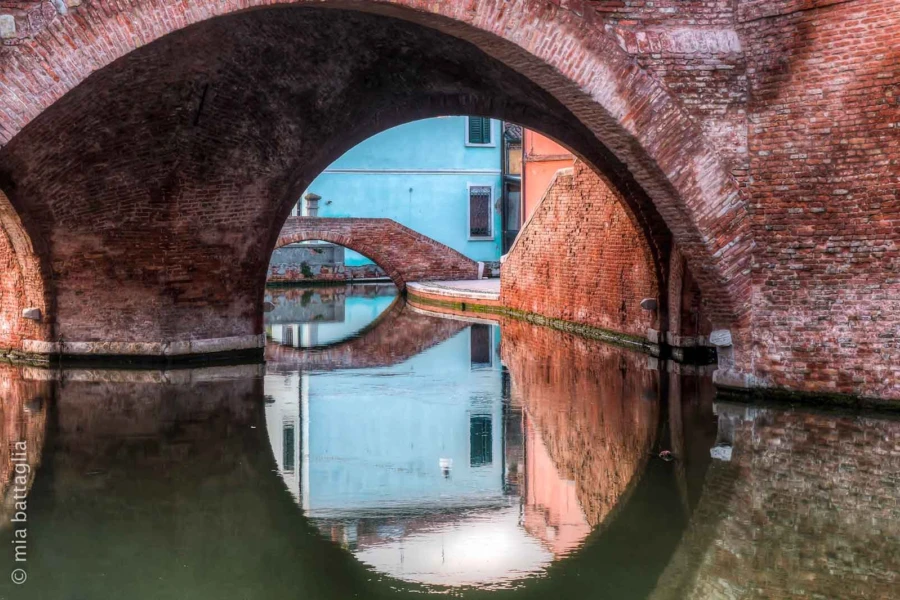
Most travelers rush to Venice.
But what if you could discover a secret corner of Italy that few even know exists?
Have you ever seen flamingos up close, wandered quiet canals, or tasted eels in a centuries-old tradition?
Comacchio, set in the serene Po Delta lagoon near Bologna, offers all this and more.
Here’s exactly what to do in Comacchio, Italy, for an unforgettable day trip.
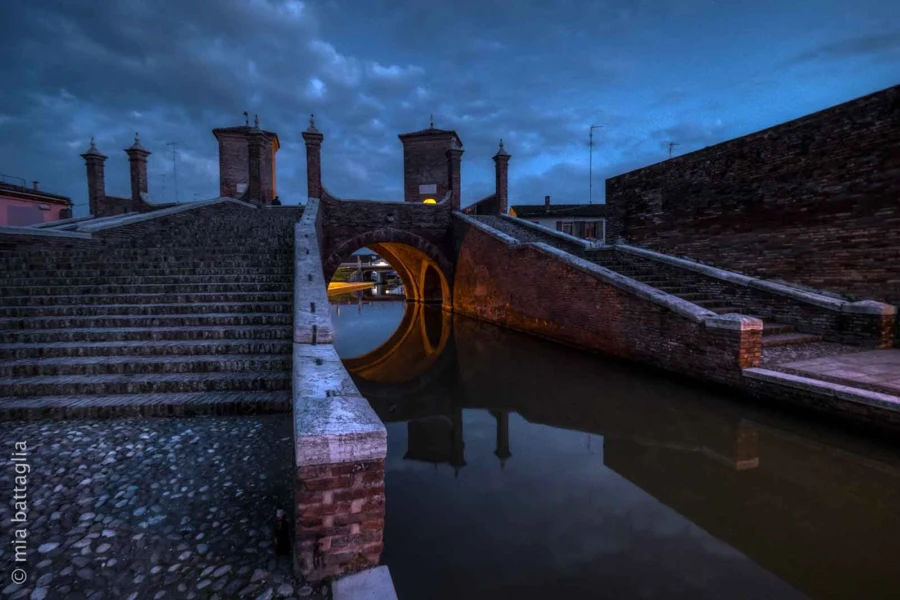
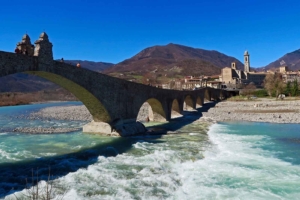
Trepponti bridge in Comacchio
Comacchio is a small Italian gem for travelers who avoid crowds.
It’s not the easiest place to reach, you’ll need a car, but its quiet canals, pastel houses, and slightly decadent charm make it uniquely authentic.
For anyone seeking off-the-beaten-path experiences and local traditions, it’s absolutely worth a visit.
If you search for Comacchio online, you’ll find everyone calling it "The Little Venice."
Let’s clear the air: Comacchio is not Venice.
Besides the canals and the fact that you walk on bridges, they have almost nothing in common.
Venice is a grand, crowded theater; Comacchio is a quiet, salt-crusted, and slightly decaying fishing village.
Its origins are deeply tied to the water.
The name itself likely comes from the Greek Kuma (wave) or the Latin Commeatulus (a group of boats), reflecting its birth on 13 small islands in the 7th century.
Comacchio is a place with its own soul, a bit melancholic and deeply authentic. If you’re looking for a polished tourist experience, you’ll be disappointed.
But if you hate overtourism and want to see a side of Italy that doesn't care about being "Instagrammable," then yes, it’s absolutely worth the trip.
- February: usually, I’d tell you to stay away from the lagoon in the dead of winter.
But for two weekends in February, Comacchio throws a curveball. Instead of typical street floats, they have a water carnival where allegorical boats parade through the canals. If you are traveling with kids, this is the time to go. - October: this is the best time. The famous Po Delta fog (nebbia) begins to settle, making the town look like a movie set. Most importantly, it’s the month of the Sagra dell’Anguilla (Eel Festival). The town smells of wood smoke and grilled fish, and the atmosphere is thick with tradition.
- Spring (April – May): the best time for nature lovers. The weather is mild enough for bike rides to the salt pans, and the flamingos are out in full force. A fair warning: bring the strongest mosquito repellent you can find. In the wetlands, they are the real local authorities.
- Summer (July – August): honestly? Avoid it. It’s sweltering hot, the humidity is brutal, and the mosquitoes will eat you alive. If you are in the area, head to the Ravenna beaches for a swim, but save the town visit for a cooler day.
- Winter (non-carnival): cold, damp, and lonely. Unless you’re a photographer looking for vibes or a fan of moody Italian cinema, you might find it a bit too melancholic.
Yes, it’s part of the Po Delta Park, a UNESCO World Heritage site since 1999.
It’s recognized not just for the buildings, but for how humans and nature have co-existed in this weird, watery landscape for centuries.
Don't look for a "to-do" list of 50 museums.
Comacchio is a place to be felt, not just checked off.
Start your visit from Trepponti (literally 3 bridges), the symbol of Comacchio and an entrance gate to the city.
This unusual bridge, designed by Luca Danese in 1638, connects 4 canals and 5 streets.
Admire the view and read the poetic inscription by Torquato Tasso on one of the towers.
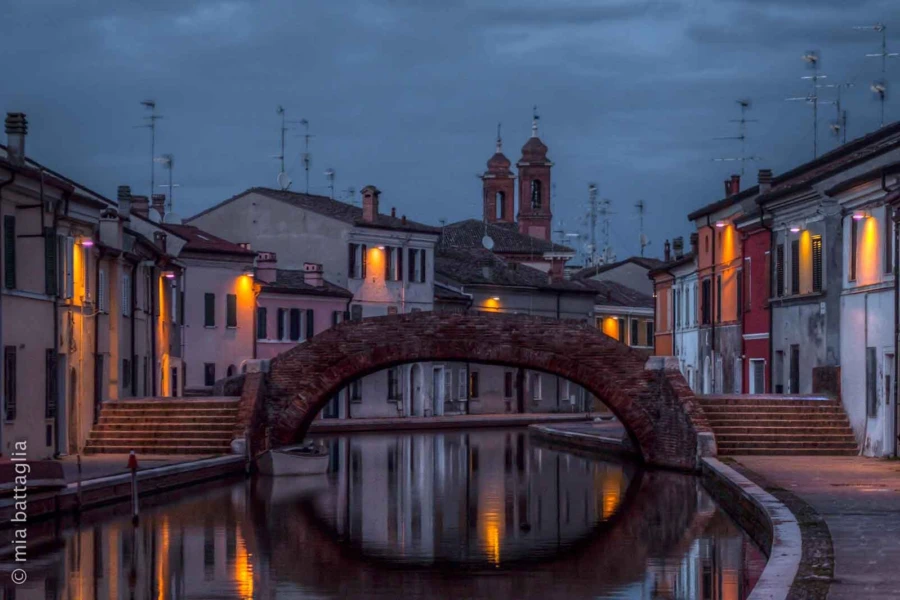
Walk along the canals to Ponte degli Sbirri (Cops Bridge).
It sits right in front of the old prison.
Its name comes from the fiocinini: local men who used to hunt eels illegally in the lagoon’s thick fog. This bridge marks the "core" of the town, where the houses are painted in colors that look best under a misty, grey sky.
During your wanderings, stop for a coffee under Loggia dei Mercanti, the former public granary. It has a nice portico with marble columns and brick arches.
Museo Delta Antico is a small museum housed in an old 18th-century hospital.
The highlight?
The Roman ship of Comacchio.
The cargo was perfectly preserved, including amphorae of fine wine still intact after 2,000 years. It’s a direct link to the ancient Etruscan city of Spina that once stood nearby.
The Loggiato is a seemingly endless portico (142 arches!) that leads you out of the center. It was built to protect people on their way to the Sanctuary of the Madonna del Popolo at the end.
Halfway through, stop at the Manifattura dei Marinati.
It’s a working factory-museum where they still roast eels over 12 giant fireplaces in the Sala dei Fuochi (Room of Fires), according to a 17th-century recipe.
The smell of wood smoke and vinegar is the true "perfume" of Comacchio.
Yes, real pink flamingos.
They live in the saltworks (Salina di Comacchio).
You can’t just wander in (it's a protected area), so you’ll need to book a guided bike tour or a boat excursion. For the best viewing experience, bring binoculars and a telephoto lens.
It’s worth the 10-minute drive from the center.
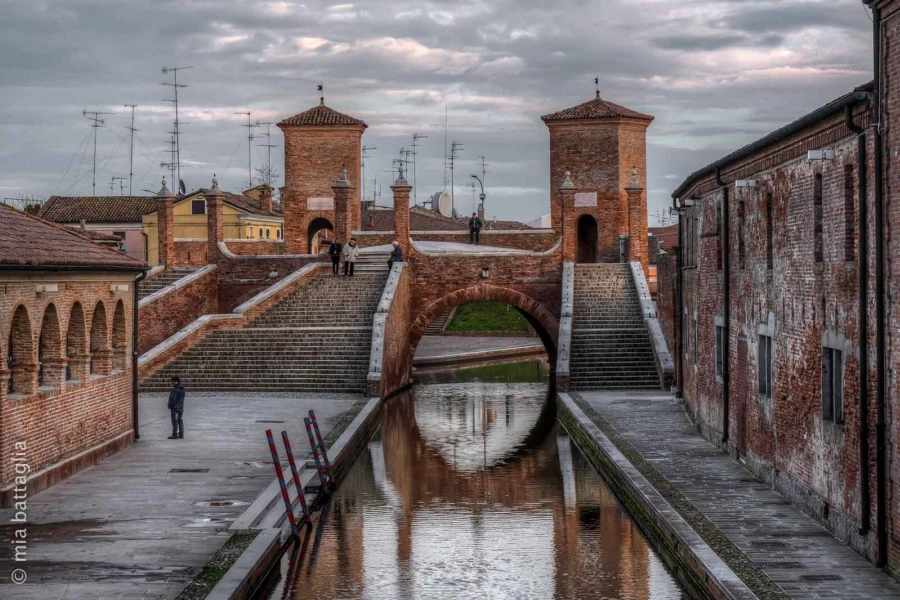
Comacchio is compact.
If you are a slow traveler, you can spend a full day here getting lost in the lagoon.
But let’s be real: if you aren't interested in the nature of the Po Delta, you can easily "do" the town in a morning.
The morning "town-only" express
If you just want the vibe, the photos, and the food, follow this plan:
- 9:30 AM: arrive and park near the Trepponti.
- 10:00 AM - 12:00 PM: walk the center, see the Cops Bridge, visit the Manifattura dei Marinati (for the smells and history), and do a quick lap of the colored houses.
- 12:30 PM: the "Queen Lunch." Sit down for a proper grilled eel or a seafood pasta.
Afternoon: the best day trip combo
By 2:30 PM, you’ve seen the best of the town.
Since you already have a car (remember, you need one!), you are in the perfect position to visit one of the two best day trips from Bologna. Comacchio sits right between them:
- Option A: Ferrara (the Renaissance choice). A 40-minute drive inland. It’s a city of bicycles, massive castle moats, and some of the best Renaissance architecture in Italy. It’s a perfect contrast to the raw, salty vibe of Comacchio.
- Option B: Ravenna (the mosaic choice). A 35-minute drive south. Home to eight UNESCO World Heritage sites. If you want to see the most incredible gold mosaics on the planet, this is where you go. By the way, we run a Ravenna Food & Mosaic tour if you want to dive deep there.
The full day: for nature lovers
If you do care about the environment, skip the other cities.
After lunch, drive 10 minutes to Stazione Foce.
- The lagoon boat tour: see the Casoni (old fishing stations) where eel fishermen lived for months in total isolation.
- The salina: this is where you find the flamingos. It’s quiet, wild, and looks like a different planet.
Comacchio Map
I’ve pinned the essential landmarks for your visit.
You can save this map to your Google Maps app by clicking the star icon.
It includes the best parking spot, my favorite restaurants for eel, and the secret spots to see flamingos in the lagoon.
Let’s talk about the elephant in the room: the eel.
In Comacchio, it’s not just food; it’s an obsession. They call it the "Queen of the Valley."
If you’re used to lean, flaky white fish, the eel will surprise you.
It’s fatty, rich, and incredibly flavorful. It’s not for everyone, but you can't say you've visited Comacchio without trying it.
- Grilled (Alla Brace): the gold standard. The skin gets crispy, and the fat melts away, leaving the meat tender and smoky.
- Marinated: cooked then preserved in vinegar. It’s sharp, intense, and very traditional (but not for everybody).
- Risotto di Vallata: a creamy risotto made with eel and other lagoon fish. Comfort food at its best.
- Trattoria Vasco e Giulia: no-nonsense, traditional, and right on the canal. Start with gratin scallops or a clam stew, then go straight to the eel. Grilled, with risotto, marinated, or with savoy cabbage: it's always delicious. Recommended by me, and Slow Food.
- Antica Trattoria La Barcaccia: a classic. They know exactly what they’re doing with the local catch.
- Al Cantinon: located right by the Trepponti. 3 brothers opened it in 1995 and now it's a reference for eel in Comacchio, with a full menu dedicated to it. A bit more "scenic," but the quality of the eel is top-notch.
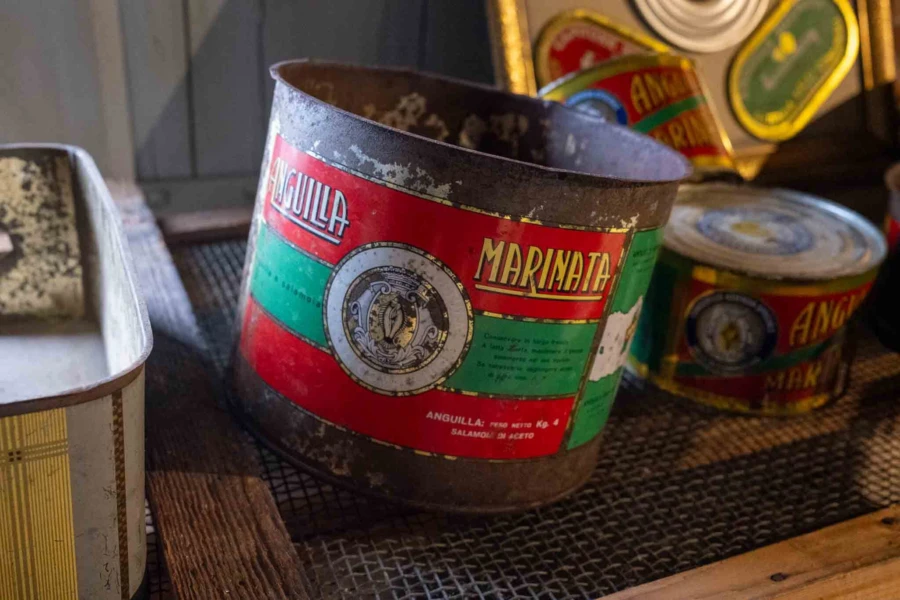
Tin of marinated eel at the museum Manifattura dei Marinati
Forget plastic magnets or cheap trinkets.
In Comacchio, the only souvenir worth carrying home is something you can eat (or the iconic vessel it comes in). The town’s history is literally preserved in vinegar and salt.
The iconic blue tin: traditional marinated eel
If you only buy one thing, make it the Anguilla Marinata Tradizionale.
- Why it’s special: it is a Slow Food Presidium. The wild eel is caught only in late autumn when the migration begins.
- The process: this isn't industrial food. The eels are hand-cut and roasted over twelve giant wood-fired chimneys in the Sala dei Fuochi. They are preserved in a traditional brine of white wine vinegar, Cervia sea salt, and bay leaves.
- The design: the vintage-style silk-screened tin is a piece of art.
Local secret: if you aren’t a fan of the strong marinated flavor, you can actually buy just the empty tin at the Manifattura dei Marinati.
It is iconic, sturdy, and makes a perfect, unique fruit bowl or tray for your kitchen.
"Sand Wine" and Po Delta rice
- Vino delle Sabbie (Fortana): this wine grows in the salty, sandy soil of the coast. It’s a "marine" wine, tannic, slightly sparkling, and acidic. It’s the only thing that can cut through the rich fat of grilled eel.
- Riso del Delta del Po: this area is one of Italy’s rice bowls. The brackish water gives the rice (usually Carnaroli or Arborio) a unique natural sapidity.
The bakery stop: eel-shaped treats
Visit a local forno (bakery) for Biscotti a forma di anguilla. These shortcrust cookies shaped like eels are a playful nod to the town’s obsession.
You might also find the Topino, a traditional mouse-shaped cake that is a staple for local kids.
I’ll be honest with you: you need a car.
Comacchio is about a 1 hour and 15-minute drive from Bologna and 45 minutes from Ferrara.
There is plenty of parking around the perimeter of the town (try the "Parcheggio Fattibello").
If you are staying in Bologna, don't even try the bus/train combo for a day trip: you’ll spend 5 hours traveling.
Rent a car for the day.
It’s the only way to have enough time to see both the town and the lagoon.
Comacchio doesn't have a train station. This is the part that surprises most tourists.
The nearest stations are Ferrara or Ravenna.
From there, you have to take a Tper bus.
It’s doable, but the schedules can be tricky, especially on weekends or outside of the summer season.
If you choose this route, check the Tper website in advance and prepare for a long ride.
Photo Credits: Mia Battaglia @Creative Commons
Related post
Tasty newsletter
Stay in touch with monthly news and get my PDF guide with the best restaurants in Bologna and beyond