Parmigiano Reggiano: aging guide, labels & how to choose the real one

Ever felt lost at the cheese counter? Five wedges, five different prices, and zero clues.
In Bologna, your choice of Parmigiano Reggiano is a serious matter: it’s the backbone of every meal we serve.
But how do you pick the right one?
Whether you need a milky 12-month snack or a crumbly, aged Parmigiano Reggiano masterpiece, stop guessing.
Here is how to choose, taste, and buy exactly like a local.
Have you ever wondered how a cheese can have such a complex flavor starting with only three ingredients?
Milk, salt, and rennet.
That’s it.
No preservatives, no additives, no "natural flavors."
The magic lies in the DOP (Protected Designation of Origin) regulations.
Every wheel must be produced in a specific area: Parma, Reggio Emilia, Modena, and parts of Mantua and Bologna.
It’s a slow process that requires 500 liters (131 gallons) of high-quality milk for every single wheel. If you think it’s expensive, imagine the care needed to turn and brush a 40kg wheel every week for years.
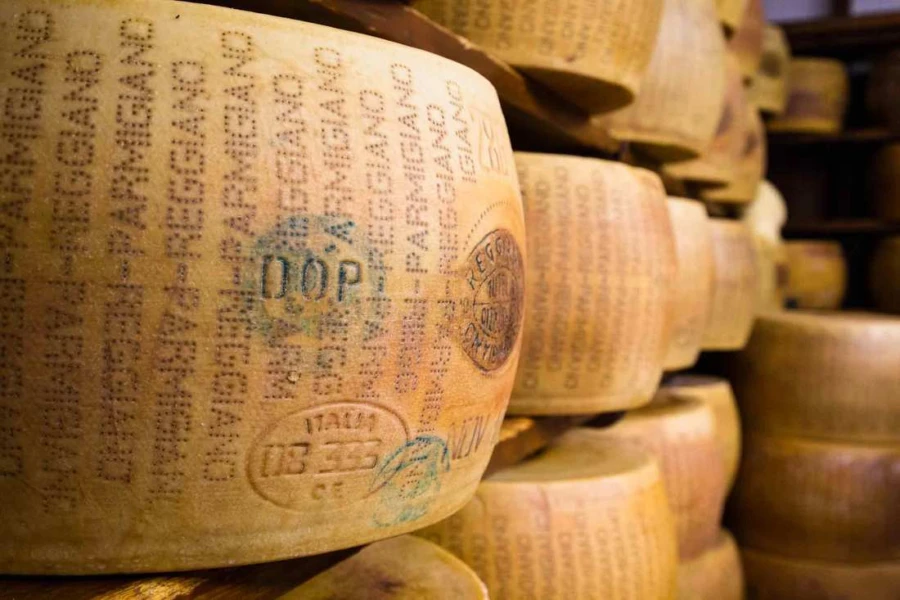
Parmigiano Reggiano cheese is aged on wooden shelves for at least 12 months
Age isn't just a number; it’s a radical personality change.
As time passes, water evaporates and flavors concentrate.
But "older" doesn't always mean "better." It depends on your goal.
Parmigiano Reggiano is aged for a minimum of 12 months, with common maturations at 24, 36 and up to 100 months, each offering different texture, flavor and culinary uses.
At 12 months, Parmigiano Reggiano is at its most "innocent" stage.
The cheese is still remarkably flexible and pale in color, reflecting its high moisture content.
At this age, you won't find the famous crunch yet; instead, the texture is smooth and slightly elastic.
On the palate, it’s a burst of fresh milk, yogurt, and green grass. It’s acidic and light, which makes it a dangerous companion for an afternoon snack—it’s very easy to eat too much of it.
Best usage: don’t grate this. It will clump up because of the moisture.
Instead, slice it into thin carpaccio-style leaves or cubes. It pairs beautifully with raw vegetables, honey, or a crisp glass of Pignoletto from the Bologna hills.
If you are traveling with kids, this is the version they will love most.
Ask Alberto, my trusted deli owner in Bologna: he’ll tell you this is the "sweet spot."
The texture becomes grainy, and those tiny white crystals start to crunch under your teeth.
These aren't salt—they are tyrosine crystals, the signature of a cheese that has reached structural maturity.
The flavor shifts from milky to deeply savory. You’ll start to taste melted butter, toasted nuts, and hints of sweet dried fruit.
The Bologna Rule: In our city, 24 months is the law for tortellini filling.
Why?
Because it’s savory enough to balance the fatty richness of the Mortadella and pork loin, but it still retains enough moisture to keep the filling silky.
This is also the cheese you want on your Tagliatelle al Ragù.
It doesn't just sit on top; it merges with the sauce.
In fact, we spend a lot of time discussing this 'magic ratio' during our Classic Bologna Food Tour, where we see how the cheese transforms a simple pasta dish.
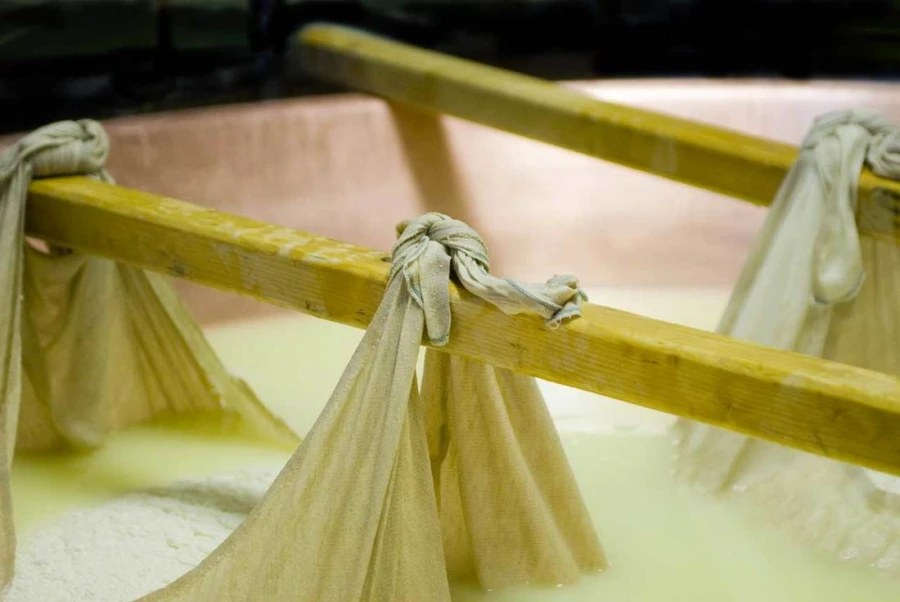
Parmigiano Reggiano cheese wrapped in cloth, ready to take its typical shape
Now we are talking about a serious, "meditation" cheese.
At 36 months, Parmigiano is dry, very crumbly, and deeply complex. The moisture is mostly gone, leaving behind a concentration of umami that will make your tongue tingle.
The aromas are much darker: think of dried fruits, spices, nutmeg, and roasted nuts. The taste is decidedly more savory and slightly spicy, though never aggressive.
The health fact: this is the ultimate "free-from" cheese.
During these three years, the milk enzymes have fully broken down the lactose, making it 100% safe for those with lactose intolerance.
It’s also incredibly easy to digest, which is why Italian pediatricians often recommend it for toddlers.
Pairing: this cheese needs a partner that can stand its ground. A few drops of Traditional Balsamic Vinegar of Modena and a glass of Lambrusco or a structured Sangiovese are the only things you need for a life-changing tasting.
Entering the 40+ month territory is like drinking a vintage Riserva wine.
It’s rare to find these wheels because not every wheel of Parmigiano is structurally perfect enough to survive such long aging without cracking or drying out too much.
The texture is almost "sandy," and the flavor is incredibly persistent. You’ll find notes of hay, tobacco, and toasted wood. The 60 or 90-month versions are legendary—they lose almost all their sweetness in favor of a deep, toasted complexity.
Expert advice: don’t cook with this. It’s a waste. Treat it like a fine dark chocolate or a rare spirit.
Take a small flake, let it melt slowly on your tongue, and enjoy the evolution of flavors. It’s a pure expression of time.
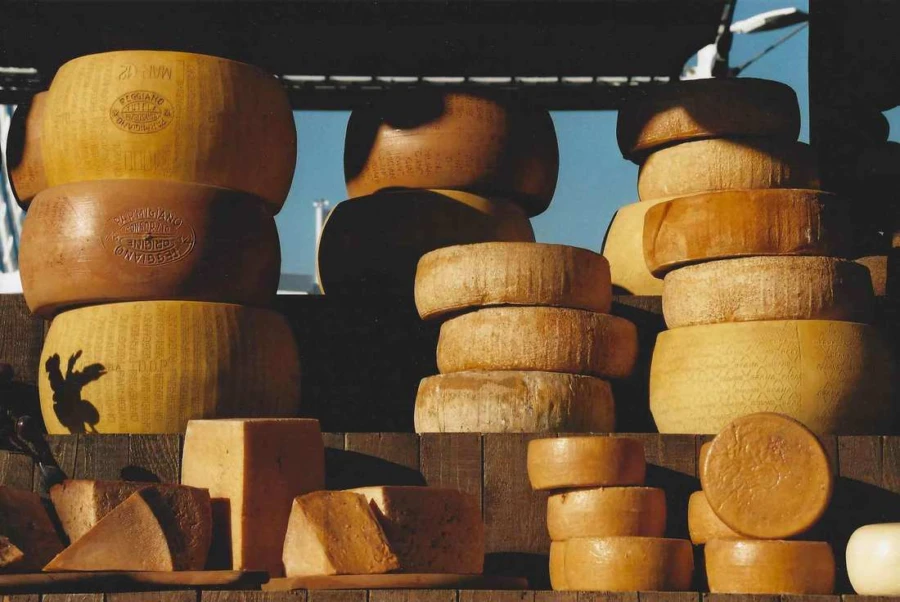
Think you’re safe just because you’re shopping in the heart of Italy?
Think again.
Navigating the cheese aisle is a minefield even on home turf.
Between generic "hard cheeses" and clever marketing, it’s easy to settle for a mediocre imitation when you were looking for greatness.
Whether you are at a local supermarket in Bologna or a deli in London, if you want the real deal—the true King—you have to look for the scars of authenticity.
The real one is "tattooed" from birth.
Look for the pin-dot indentations spelling out "Parmigiano Reggiano" across the rind.
But there is a second, even more specific mark: the Matricola.
Every single dairy has a unique four-digit identification number.
If you see a number like 101, 327, or 2121 embossed on the rind, that is the dairy's "license plate."
You can actually go to the Consortium’s website, type that number in, and find the exact farm where your cheese was born. If a wedge has no number and no dots, it didn’t come from an authorized dairy. Period.
Look for the yellow and red DOP (PDO) symbol.
This is your legal shield. However, in Italian supermarkets, you might notice some wheels with parallel lines carved all the way around the middle.
This is Parmigiano Reggiano Mezzano.
These wheels passed the quality test but showed small structural flaws (like tiny air bubbles).
They are perfectly safe and delicious, but they aren't meant for long aging.
They are usually sold young (12-15 months) at a lower price.
It's a great "budget" hack for everyday cooking, as long as you know you aren't buying a 36-month masterpiece.
In the EU, the law is clear: "Parmesan" can only be used to sell authentic Parmigiano Reggiano.
But the moment you cross the ocean, the rules vanish.
In the US, Australia, or South America, "Parmesan" is a generic term.
It could be a plastic-like block, a domestic imitation, or, worst of all, that salty dust found in green shakers.
The rule is simple: if the label doesn't say Parmigiano Reggiano, it’s not the King.
Don't be seduced by Italian flags on the packaging or pictures of rolling hills. If the name is translated or says "Italian-style," it’s an imitation.
Don't let a generic name rob you of the real experience.
In the world of Italian hard cheeses (formaggi a pasta dura), the King has some very respectable cousins.
You will find them sitting right next to the Parmigiano, and they are excellent cheeses in their own right, but the Disciplinare (the rulebook) is different.
- Grana Padano: this is the most produced DOP cheese in the world. The production area is much larger than Parmigiano's.
The main difference? The cows' diet.
For Grana Padano, cows are allowed to eat insilati (silage/fermented forage). This is strictly forbidden for Parmigiano Reggiano cows, who must only eat fresh grass and hay. This makes Grana generally milder and less complex than Parmigiano. - Trentingrana: this is a specific, high-quality variety of Grana produced in the mountains of Trentino (Dolomites). Interestingly, their rules are stricter than standard Grana, like Parmigiano, they also ban silage. It’s a wonderful, elegant cheese that tastes of mountain herbs.
The takeaway?
Don't call them "fakes." They are authentic Italian treasures.
But if your heart (or your recipe) demands the deep, nutty punch of the King, check the dots and the matricola.
Think all Parmigiano tastes the same?
Take a deeper look at the cows. While 90% of production relies on the Friesian (the classic black and white one), the real insiders hunt for the rare breeds.
It’s like the difference between a mass-market wine and a single-vineyard Cru.
- The red cow (Vacca Rossa): this is the Reggiana breed. Their milk is richer in proteins and fats, which allows the cheese to age for 40 months or more without losing its creaminess. It’s the Ferrari of Parmigiano—intense, nutty, and deeply aromatic. Because it's so unique, we always include a dedicated tasting of the Red Cow variety on our Parma Food Tour, so you can compare it side-by-side with the standard breeds.
- The white cow (Bianca Modenese): almost extinct, this breed gives a delicate, floral milk. Production is tiny, so if you find a wedge with this label, buy it immediately.
- The brown cow (Bruna Alpina): known for a very buttery, rich flavor that feels incredibly smooth on the palate.
If you see a label saying "Prodotto di Montagna" (Mountain Product), pay the extra couple of euros.
Why?
Because cows grazing at high altitudes eat a biodiversity of herbs and flowers that simply don't exist on the plains of the Po Valley.
The resulting cheese is yellower, sweeter, and smells like fresh hay and wildflowers. It’s a completely different sensory experience.
You’ve spent money on a 30-month masterpiece; don't let it turn into a flavorless rock in your fridge.
The biggest enemy of Parmigiano is plastic wrap.
It suffocates the cheese, makes the fat go rancid, and creates a "refrigerator" aftertaste.
The local way: if you buy your wedge at a local market—like the historic Mercato Albinelli in Modena—the vendor will wrap it in professional-grade parchment paper.
Keep that paper. It’s designed to let the cheese breathe while maintaining the right humidity.
If you don't have it, a clean, dry cotton cloth is your best alternative.
Where to put it: store it on the higher shelves of your fridge, where the temperature is most consistent, just like you would with any high-quality cheese.
Pro tip: never throw away the rind.
Scrub it clean with a brush and toss it into your next minestrone or tomato sauce while it simmers. It softens up and releases a massive umami punch.
In Bologna, the boiled rind is a chef's secret treat.
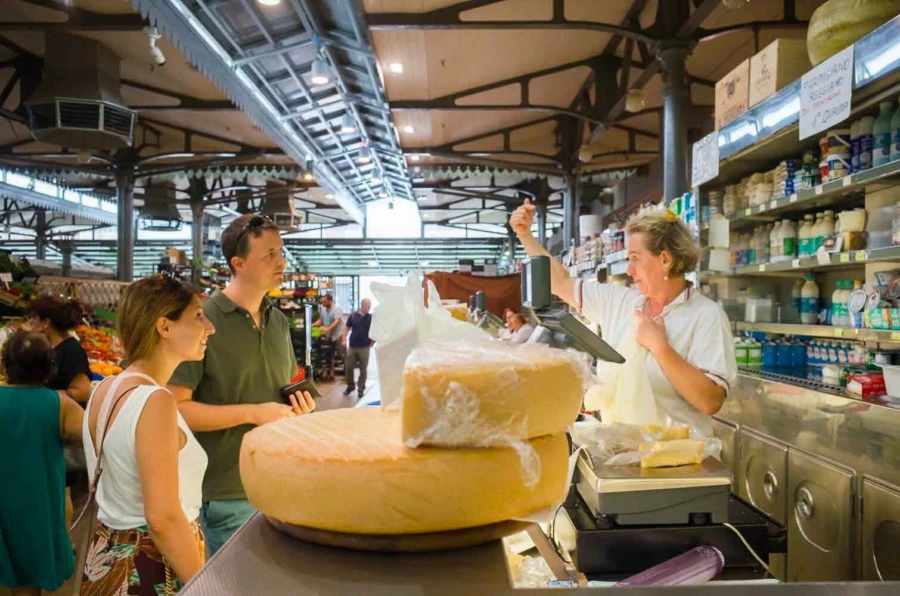
Mercato Albinelli in Modena is one of the best places in Italy to find high-quality Parmigiano Reggiano
Pairing Parmigiano Reggiano is an art of balance.
As the cheese ages, its structure becomes more complex and its savory notes more intense, meaning you need a companion that can keep up without being overwhelmed.
In Emilia Romagna, we keep it simple: fresh and light for the young wedges, structured and intense for the old ones.
What are those white crunchy spots? Is it salt?
No. They are tyrosine crystals—amino acids that form as the proteins break down during aging. They are the "gold nuggets" of Parmigiano. The crunchier the cheese, the better it has aged.
Is it safe for lactose-intolerant people?
Yes. Due to the long fermentation and aging, the lactose is naturally transformed. By the 24-month mark, the lactose level is virtually zero. It’s one of the few safe bets for sensitive stomachs.
How many calories are in a serving?
A 20-gram flake (roughly the size of two thumbs) is about 80 calories. It’s a nutrient-dense powerhouse, packed with more calcium and phosphorus than almost any other food. It’s the original Italian "power snack."
Conclusion: quality over quantity
Next time you find yourself at a cheese counter, whether it’s in a Bologna food market or at your local deli back home, don’t just look at the price tag.
Look for the pin-dots, check for the dairy’s unique ID number, and ask about the maturation.
The beauty of Parmigiano Reggiano is that you don't need much of it.
A small, 200g wedge of a high-quality, 30-month stravecchio will provide more flavor, more nutrients, and more satisfaction than a massive block of generic "Parmesan."
By choosing the real thing, you aren't just buying cheese; you are supporting a 900-year-old tradition of farmers and cheesemakers who refuse to take shortcuts.
It is a living product that tells the story of our territory, our cows, and the slow, patient passing of time.
Eat it slowly.
Share it with friends.
And most importantly, keep the rind for your soup.
[Photos: Centotre Contini, Claudio Manenti, Wonsun, Cristian]
Related post


Tasty newsletter
Stay in touch with monthly news and get my PDF guide with the best restaurants in Bologna and beyond