Best Tortellini in Bologna: Where to Eat Tortellini in Brodo (2026)
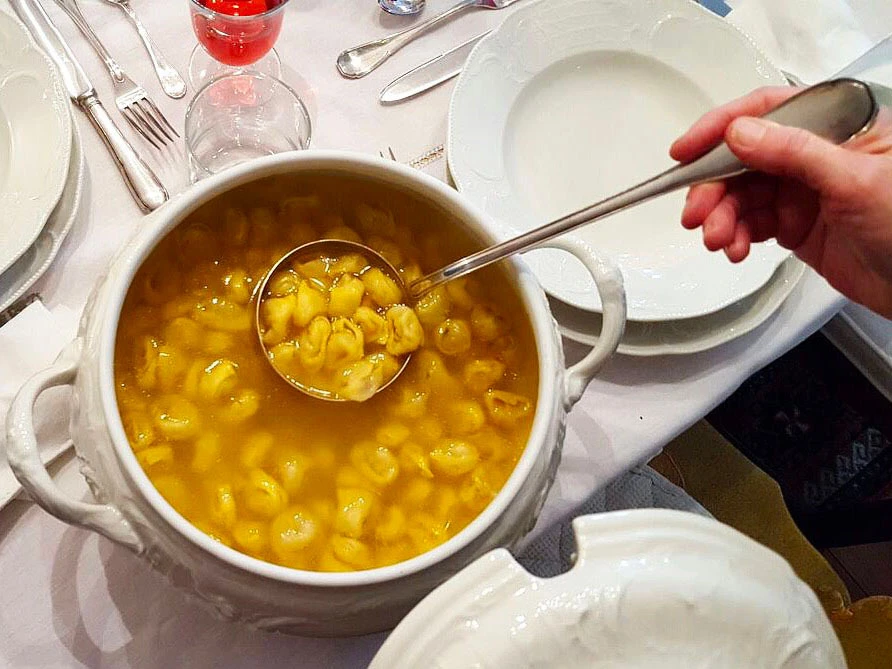
Every Bolognese has a tortellini place, and every Bolognese thinks the others are wrong.
I've been eating them in this city all my life, so here's my shortlist: where to eat the best tortellini in brodo in Bologna, where to buy them fresh, and the official recipe if you want to fold 1,000 of them at home.
In Bologna, tortellini belong in broth. Clear, rich, made with beef and hen, never from a cube.
That's the version to judge a place by.
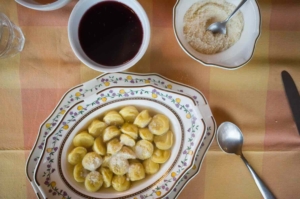
How to spot a good one at the table: the tortellini are small (five should fit on a spoon), the pasta is thin but still has a bite, and the broth is clean enough to see the bottom of the bowl.
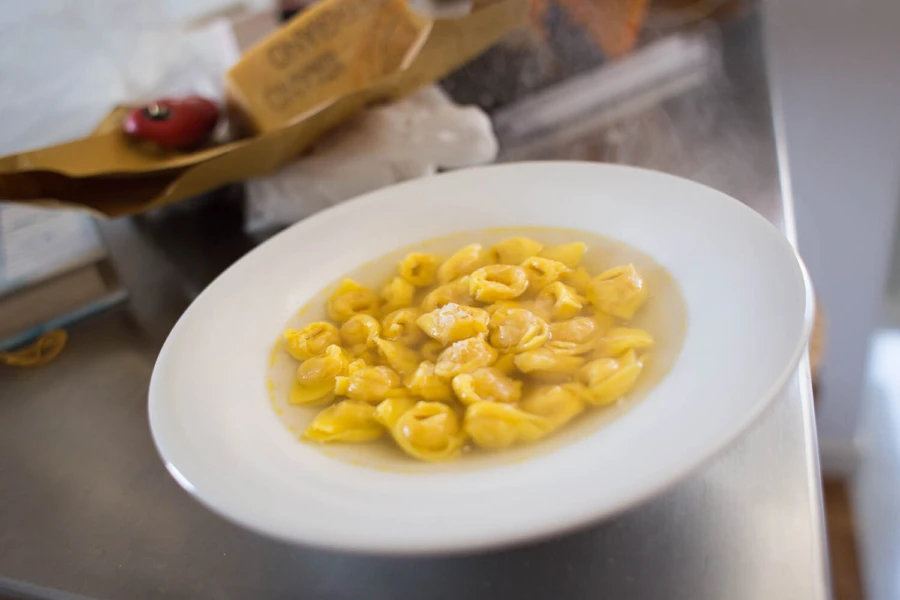
The benchmark.
Tortellini in brodo exactly as they should be: small, even, with a broth that tastes of meat and nothing else. It's also one of the best places in town for cured meats, so order a plate of culatello while you wait.
Where: Via Santa Caterina 51, 40123 Bologna
Tip: book ahead, it fills up with locals. Read my full review of Osteria Bottega.
A small, old-school room a few steps from the Two Towers, open since 1944, when opera singer Francesco Grassilli swapped the stage for the stove.
The walls are still covered with photos of opera stars. Tortellini and tagliatelle are rolled by hand, and the kitchen has a slight French accent.
Where: Via Dal Luzzo 3
Tip: few tables, so booking is a must. In summer ask for a table outside on the quiet street.
Ring the doorbell under the wooden portico of Via de' Falegnami and you're in one of the most elegant dining rooms in town, run by the Carati family since 1980.
Refined, precise, balanced: the kind of place where you can pick any dish blindly and still win.
Where: Via de' Falegnami 4
Tip: in season, don't miss the truffle. Read my review of Caminetto d'Oro.
Under the portico of Via San Felice, where Trattoria da Danio opened in 1937.
Today Danio's granddaughter Elisa Rusconi runs the kitchen, and the fresh pasta comes from her own lab next door. Tradition on one side of the menu, some clever new ideas on the other.
Where: Via San Felice 50 (second location in Torre Galluzzi)
Tip: it's one of the most popular trattorias in Bologna, so book online a few days ahead: a credit card is required to confirm. Read my review of Trattoria da Me.
Outside the centre, in an old country courtyard along the Navile canal: you're still in Bologna but it feels like the countryside.
Start from the appetizer cart, then order the handmade tortellini in meat broth, among the best I've had in the city. It's the classic spot for a long Sunday lunch with family.
Where: Via del Sostegno 15
Tip: save room for the zuppa inglese, it's superlative. You'll need a car or taxi, or a long walk to earn it. Read my review of Da Sandro al Navile.
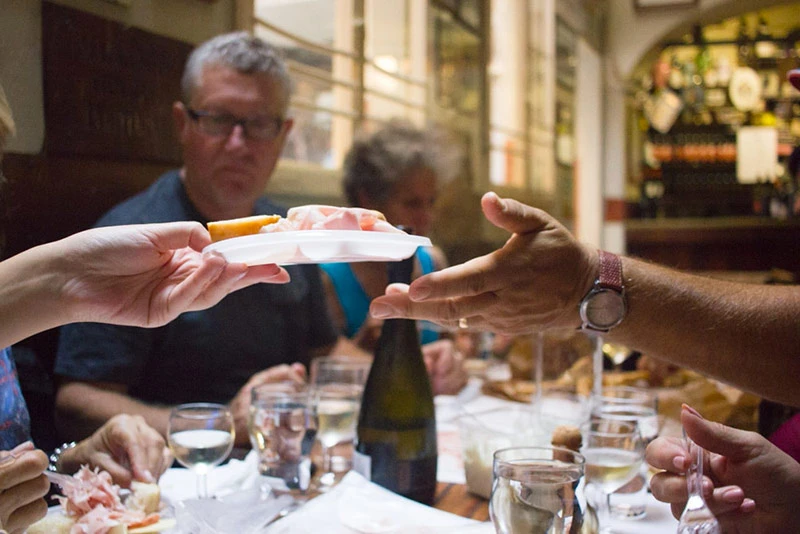
This is where the story starts. Cesarina Masi is credited with inventing tortellini alla panna in the 1940s, in the family osteria she ran with her mother in Via degli Albari.
In 1947 she opened the restaurant that still carries her name, under the porticoes of Piazza Santo Stefano. The menu hasn't chased trends in decades, and that's the point.
Where: Piazza Santo Stefano
Tip: order the tortellini alla panna, obviously. In summer ask for a table outside, facing Santo Stefano.
A contemporary osteria in Strada Maggiore with a traditional heart.
The dish to order is tortellini in 30-month Parmigiano Reggiano cream: no panna, no shortcuts, just cheese and good pasta.
Where: Strada Maggiore 10/a
Tip: the lasagne are also worth a second visit.
Not in Bologna but in San Giovanni in Persiceto, and the reason many Bolognese drive there.
Chef Franco Cimini made tortellini with panna d'affioramento famous: cream skimmed from milk left to rest overnight, the same milk that becomes Parmigiano. If you're a broth loyalist, they also serve tortellini in double hen broth.
Where: Via Giacomo Matteotti 17/A, San Giovanni in Persiceto
Tip: this is a special-occasion bill, not a trattoria one. Book well in advance and check opening days on their website.
Want to cook them yourself or take some home? These shops make them properly:
- Atti – artisanal and historic, since 1880.
- Tamburini – a beloved deli with top-quality fresh pasta.
- Le Sfogline (Via Belvedere) – handmade from scratch; you can watch them fold.
- Salumeria Bruno e Franco – tiny and perfect.
Travel tip: fresh tortellini keep for a few days in the fridge. For a flight home, ask the shop to vacuum-pack them.
Most of these are in or near the Quadrilatero, so you can combine them with a walk through the Bologna food markets.
Tortellini have medieval roots, though their exact origin is still debated.
Some say they were born in 1095 in Bologna, created to honor crusaders before they left for the Holy Land.
The first written mention?
A story from 1289, when a student caught roaming the streets at night claimed he was simply out to buy tortellos for himself and his friends.
Historian Alessandro Cervellati cites a 12th-century Tortellum ad Natale, likely sweet pasta served to monks, not quite the tortellini we know.
By the 1300s, a Modenese recipe mentioned torteleti de enula, and even Boccaccio, in the Decameron, hinted at stuffed pasta. The name may come from torta or tortula, but no one knows for sure.
Myths, legends, and global fame
Over the centuries, tortellini moved from noble feasts to family kitchens, becoming the heart of festive meals.
The iconic mortadella? It only entered the filling in the 1800s.
That same century, engineer Paolo Ceri from Castelfranco Emilia invented the famous “Venus’s navel” legend: pure fiction, but now part of local lore. The town even hosts a Tortellino Festival every September to celebrate it.
In 1904, the Bertagni brothers introduced tortellini to the world stage at the Los Angeles Exposition, along with a method for preserving them.
Then in 1974, the Dotta Confraternita del Tortellino sealed tradition by registering the official recipe: meat-filled tortellini served in rich broth.
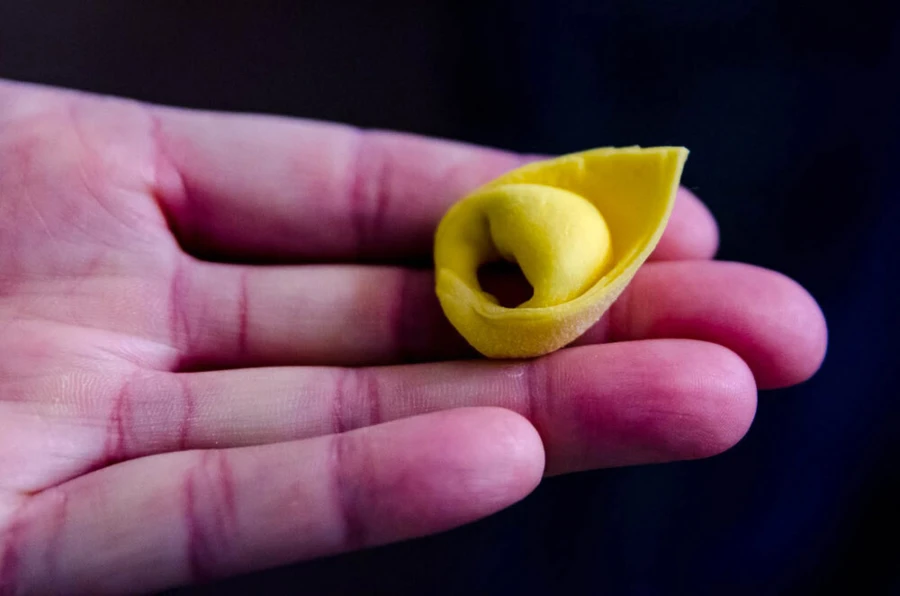
This follows the proportions of the 1974 registered recipe, scaled up to about 1,000 tortellini.
Plan ahead: the pork marinates for 48 hours and the filling rests for another 24.
Ingredients (for approx. 1000 tortellini)
For the pasta dough:
- 1 kg all-purpose flour
- 10 fresh eggs
For the filling:
- 300 g pork loin (lombo di maiale)
- 300 g prosciutto crudo
- 300 g authentic mortadella di Bologna
- 450 g Parmigiano Reggiano (aged at least 24 months)
- 3 eggs
- A pinch of grated nutmeg
For the broth:
- 1 kg beef (doppione, or shoulder/brisket cut)
- ½ free-range chicken (preferably a hen)
- 1 carrot
- 1 celery stalk
- 1 onion
- Salt to taste
Step 1: Preparing the pork loin
Authentic tortellini filling starts with care, patience, and seasoning.
- Rub the pork loin with a mix of salt, freshly ground black pepper, finely chopped rosemary, and garlic.
- Cover and let it rest in the fridge for 48 hours, allowing the flavors to penetrate deeply.
- After resting, melt a little butter in a pan and slowly brown the meat over low heat until tender and fragrant.
- Remove it from the pan, let it cool slightly, and carefully clean off the marinade (you want the flavor, not the chunks).
Step 2: Making the filling
Now it’s time to transform those flavors into the heart of your tortellini.
- Finely mince the pork loin, prosciutto, and mortadella. For best results, use a battilardo (traditional mezzaluna chopper and board) or a sharp knife. Avoid using food processors—they heat the meat and ruin the texture.
- Place the minced meat in a large bowl.
- Add grated Parmigiano Reggiano, the eggs, and a generous pinch of nutmeg.
- Mix thoroughly by hand. Keep going until the mixture is smooth, compact, and evenly blended.
- Cover the bowl and let the filling rest for 24 hours in the fridge. This step is essential—it allows the ingredients to bind and the flavors to mature.
🧠 Tip: The better the ingredients, the better the tortellini. Choose high-quality DOP mortadella and properly aged Parmigiano Reggiano for the most authentic flavor.
Step 3: Making the broth
A great tortellino deserves a broth that does it justice. Clear, rich, and aromatic: brodo is the soul of the dish.
- Place the beef and hen in a large pot with celery, carrot, onion, and a pinch of salt.
- Cover with cold water and bring to a gentle simmer over low heat.
- Skim off any foam, then let it cook slowly for at least 3 hours.
- Strain the broth, removing all solids, and keep warm.
🍗 For the most traditional result, don’t rush the broth. Some Bolognese nonne simmer it for 5–6 hours.
Step 4: Rolling the pasta
- On a floured surface, mix the flour and eggs, kneading until smooth and elastic.
- Let the dough rest under a cloth for 30 minutes.
- Roll it out very thin (ideally by hand with a mattarello), almost translucent but still strong enough to hold the filling.
- Cut the dough into 3–4 cm squares using a knife or pasta cutter.
Step 5: Folding the Tortellini
- Place a small ball of filling in the center of each square.
- Fold the square into a triangle, pressing the edges to seal.
- Wrap the two tips of the triangle around your finger and pinch them together to form the classic “navel” shape.
✨ They should be small, delicate, and uniform. In Bologna, you’re judged by how many tortellini fit on a spoon: five is ideal.
Step 6: Cooking and serving
- Bring your broth to a gentle boil.
- Drop the tortellini in and cook for about 3–4 minutes, until they rise to the surface.
- Serve immediately in a bowl of hot broth, with a sprinkle of Parmigiano Reggiano if desired.
❗ Never overcook tortellini. They must hold their shape and texture: soft, but with a gentle bite.
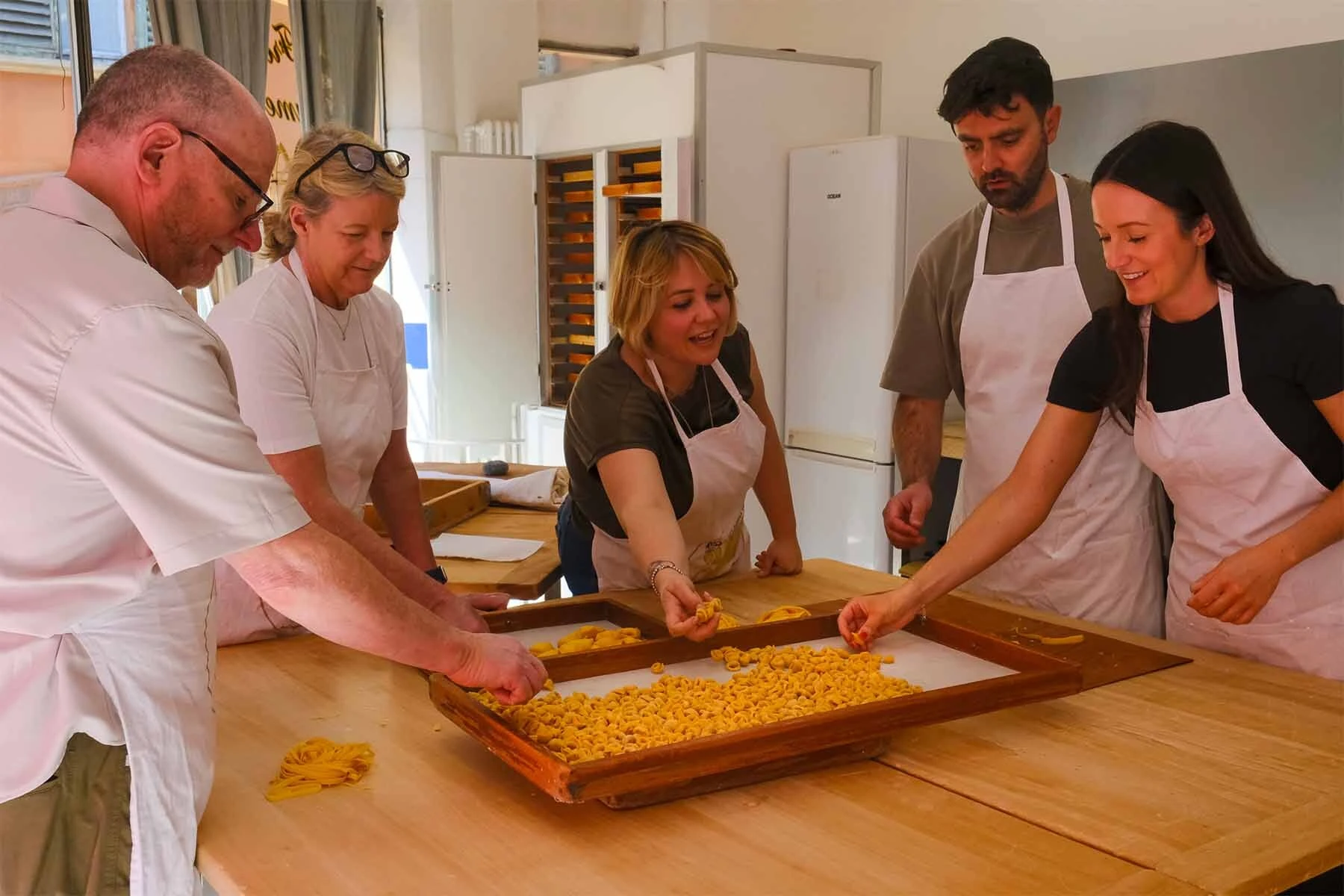
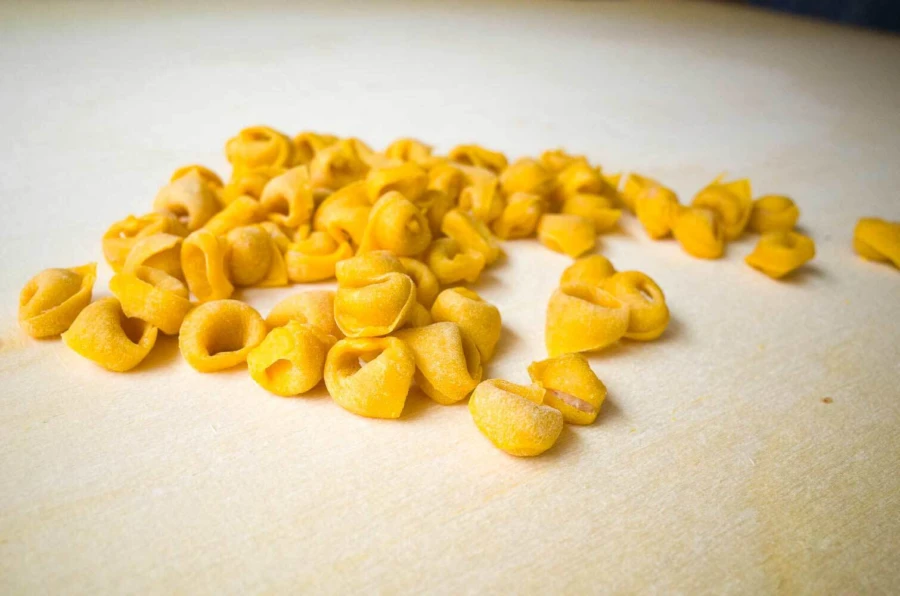
What is the difference between tortellini and tortelloni?
Let’s break it down:
So next time you see both on a menu, you'll know exactly what you’re ordering ;)
Conclusion: a love letter to Tortellini
Under Bologna’s arcades, rolling pins tap like church bells. In a back-room kitchen, floured hands flip a pasta square—twist, pinch, click—into a golden ring.
It sinks into bubbling broth - steam rises, scented with hen, bone, Parmigiano and nutmeg.
Your bowl trembles: first spoonful, silk and depth.
Second bite, filling melts.
Third, you’re inside the city’s heartbeat.
Join our Bologna food tour to watch sfogline shape miracles, breathe the clouded windows of broth, then cradle your own bowl of tortellini in brodo.
Some memories hang on walls.
The best drift on steam: come claim yours, one spoonful at a time.
Bibliography
Sua Maestà il Tortellino - Giorgio Maioli, Giancarlo Roversi - Re Enzo Editrice 1993
Related post

Tasty newsletter
Stay in touch with monthly news and get my PDF guide with the best restaurants in Bologna and beyond