[
{
"@context": "https://schema.org",
"@graph": [
{
"@type": "BlogPosting",
"@id": "https://www.tastebologna.net/blog/archiginnasio-library#article",
"headline": "Archiginnasio of Bologna: A Visitor's Guide to the Library & Anatomical Theatre",
"description": "A local's guide to Bologna's Archiginnasio — what's free to see, what needs a ticket, and the details most visitors miss.",
"image": "https://www.tastebologna.net/uploads/_1800xAUTO_crop_top-center_90_none_ns/132889/teatro-anatomico-bologna.webp",
"datePublished": "2024-06-13",
"dateModified": "2026-07-20",
"author": {
"@type": "Person",
"@id": "https://www.tastebologna.net/about-us#andrea",
"name": "Andrea Chierici",
"url": "https://www.tastebologna.net/about-us"
},
"publisher": {
"@type": "Organization",
"name": "Taste Bologna",
"logo": {
"@type": "ImageObject",
"@url": "https://www.tastebologna.net/uploads/global/Taste-Bologna-Logo.png"
}
},
"mainEntityOfPage": "https://www.tastebologna.net/blog/archiginnasio-library",
"about": [
{ "@id": "https://www.tastebologna.net/blog/archiginnasio-library#building" },
{ "@id": "https://www.tastebologna.net/blog/archiginnasio-library#theatre" }
]
},
{
"@type": "Library",
"@id": "https://www.tastebologna.net/blog/archiginnasio-library#building",
"name": "Archiginnasio of Bologna",
"description": "Historic palace built in 1562-63, former seat of the University of Bologna until 1803, now hosting the municipal library.",
"address": {
"@type": "PostalAddress",
"streetAddress": "Piazza Galvani 1",
"addressLocality": "Bologna",
"postalCode": "40124",
"addressCountry": "IT"
},
"sameAs": "https://en.wikipedia.org/wiki/Archiginnasio_of_Bologna"
},
{
"@type": "TouristAttraction",
"@id": "https://www.tastebologna.net/blog/archiginnasio-library#theatre",
"name": "Anatomical Theatre of the Archiginnasio",
"description": "The historic hall once used for anatomy lectures and dissections, famous for its wooden statues and architecture.",
"containedInPlace": {
"@id": "https://www.tastebologna.net/blog/archiginnasio-library#building"
},
"sameAs": "https://en.wikipedia.org/wiki/Anatomical_Theatre_of_Bologna"
}
]
}
]
The Archiginnasio in Bologna is one of the stops I send people to even when they're not on one of my tours.
It's a five-minute walk from Piazza Maggiore, the library is free, and almost nobody goes upstairs to the Anatomical Theatre unless they know it's there.
Here's what's free, what needs a ticket, and what's actually worth your time inside.
Visiting the Archiginnasio in Bologna
Library
Free, but a working reading room, not a sight to walk through. Go only if you plan to sit and read or work.
Anatomical Theatre
Ticketed, booking mandatory. €12 full / €10 reduced / €7 residents & Cultura Card.
Address
Piazza Galvani, 1 40124 Bologna
Nearby
Right behind San Petronio, 2-min walk from Piazza Maggiore
What's Archiginnasio in Bologna?
The University of Bologna is the oldest university in the world, founded in 1088. For over two centuries, the Archiginnasio was its home.
Cardinal Borromeo commissioned the building in 1562, and architect Antonio Morandi, known as "Terribilia", built it as part of a larger project that also gave Bologna the Neptune Fountain in the piazza next door.
The university moved out in 1803. Today the building holds the Municipal Library and, upstairs, the Anatomical Theatre.
It sits right behind San Petronio Basilica, at Piazza Galvani 1: you'll walk past it without noticing unless you're looking for the entrance, which is part of why so few tourists find their way inside.
Visit Archiginnasio
The courtyard and the coats of arms
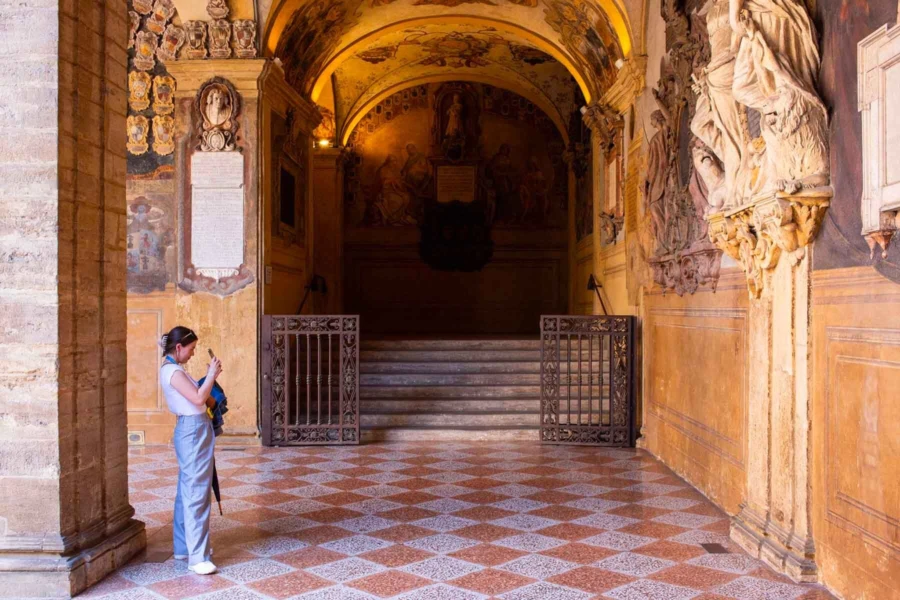
Walk in from Piazza Galvani, and the façade is the first thing that stops people: thirty arches, matching windows, and if you look closely at the decoration, carved sirens, masks, and birds worked into the stone.
Inside, the courtyard is ringed by a double loggia, and every surface, walls, vaults, staircases, is covered in painted coats of arms.
There are about 7,000 of them, each one a dedication students left behind for a professor, a rector, or a mayor. Most are gouache and oil, some centuries old, and you could spend twenty minutes just walking the loggia reading names.
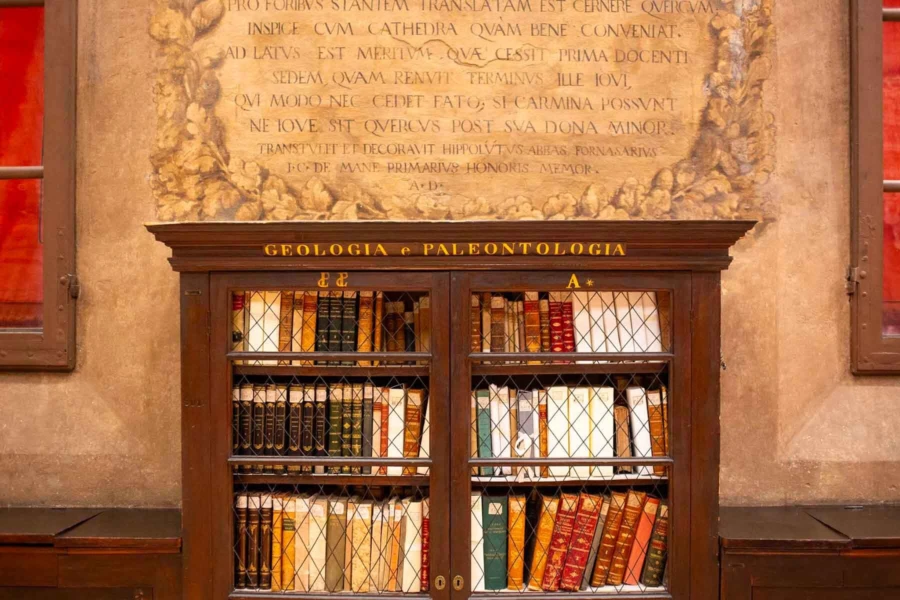
Books cabinet inside the Stabat Mater
The Anatomical Theatre
Up one of the two grand staircases, the Anatomical Theatre is the reason most people come.
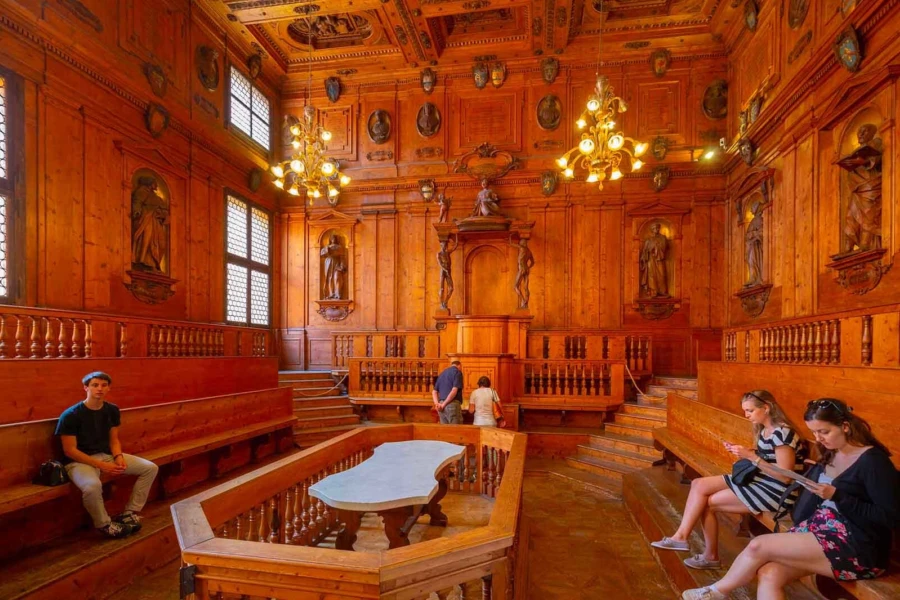
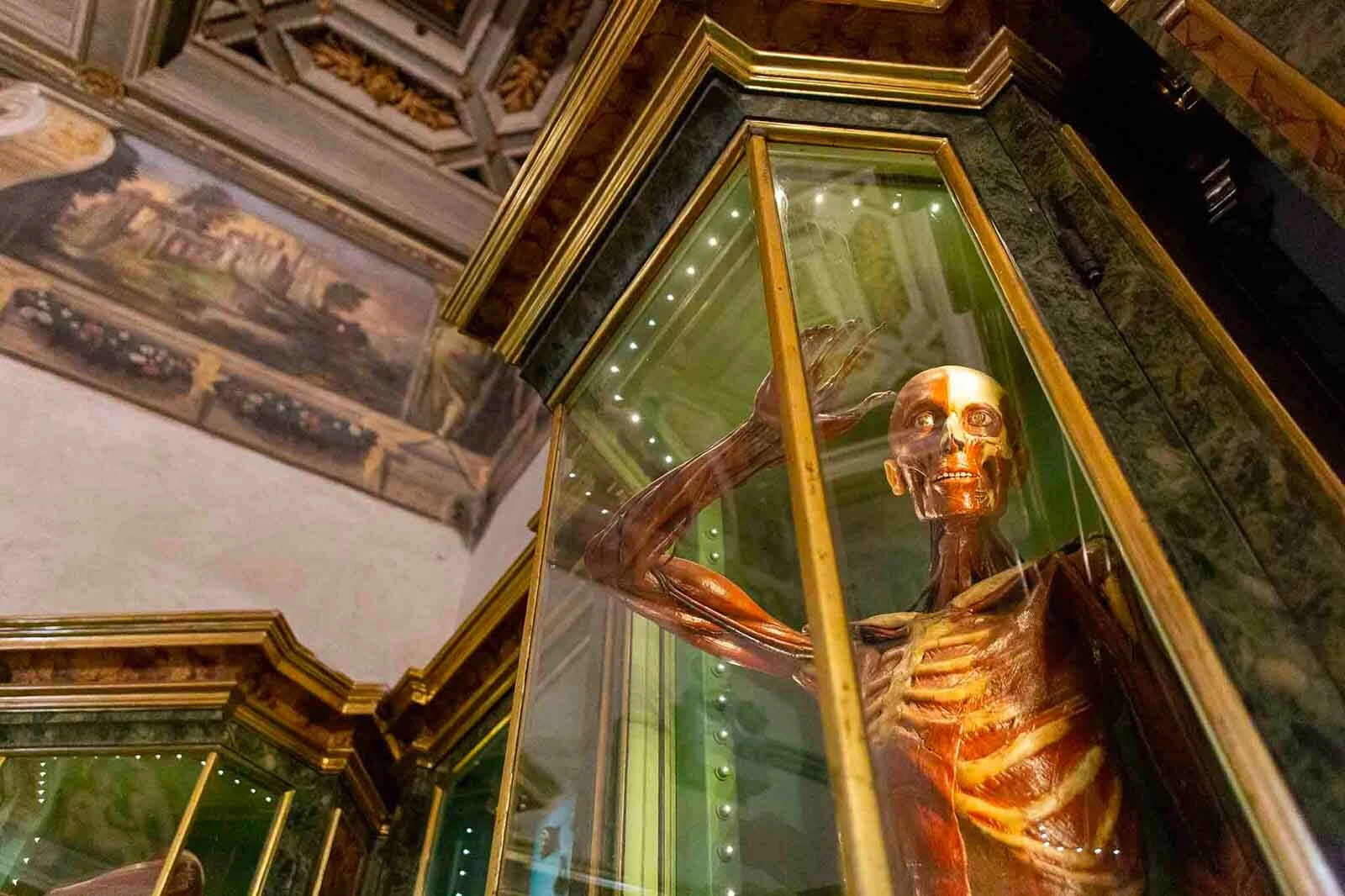
Built in 1637 out of spruce wood, it's a small room built entirely for teaching anatomy, a white marble dissecting table at the center, wooden statues called the Spellati ("the skinned ones") holding up the canopy above, and a ring of busts of famous physicians, from Hippocrates to Marcello Malpighi.
The room you see today is a careful post-war reconstruction: the original was destroyed in a WWII bombing raid, and rebuilt using what records and photographs survived.
Next to it is the Stabat Mater hall, once used by law professors, where Rossini's opera of the same name had its first performance.
From historic anatomy lectures to the soul of Bolognese food.
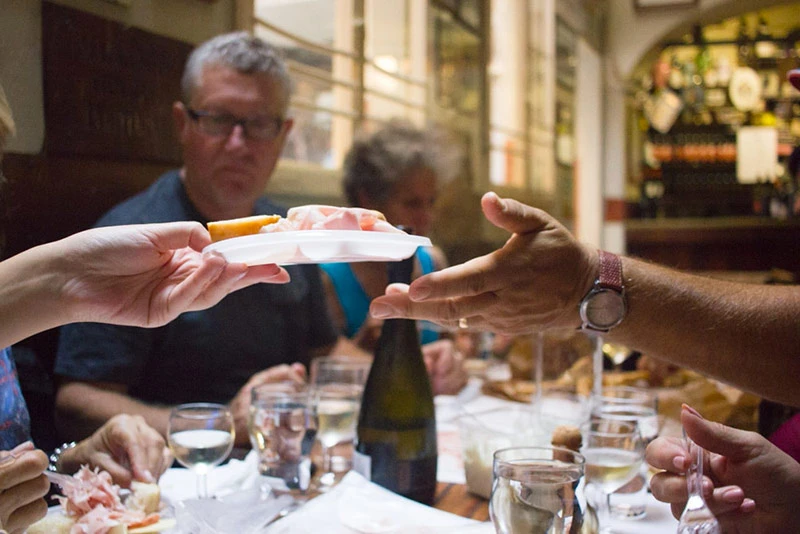
After marveling at the wooden carvings of the Anatomical Theatre, take a few steps into the neighboring Quadrilatero market alleys where a different kind of history is kept alive. Our Classic Bologna Food Tour connects the dots between the city's rich culture and its old-school food counters. Join us to taste hand-cut mortadella, aged Parmgiano, and lasagne surrounded by the same walls students walked centuries ago.
Same neighborhood, completely different kind of hands-on history.
Cross the corridor and you'll reach the library. But this isn't a sight to walk through.
It's still a working library, and access is meant for people who actually want to sit down and read: leave a bag and a document at the entrance, find a seat, and it's yours for as long as you need it.
If you're just curious and don't plan to stay, the staff may turn you away, and that's fair, it's not set up for foot traffic.
If you do go in to work or read, it's worth it for more than the quiet: manuscripts, periodicals, and books dating back to the 19th century, when the library was established in its current form. It's one of several historic libraries worth knowing in the region, though this one you can only use if you're actually planning to sit and work.
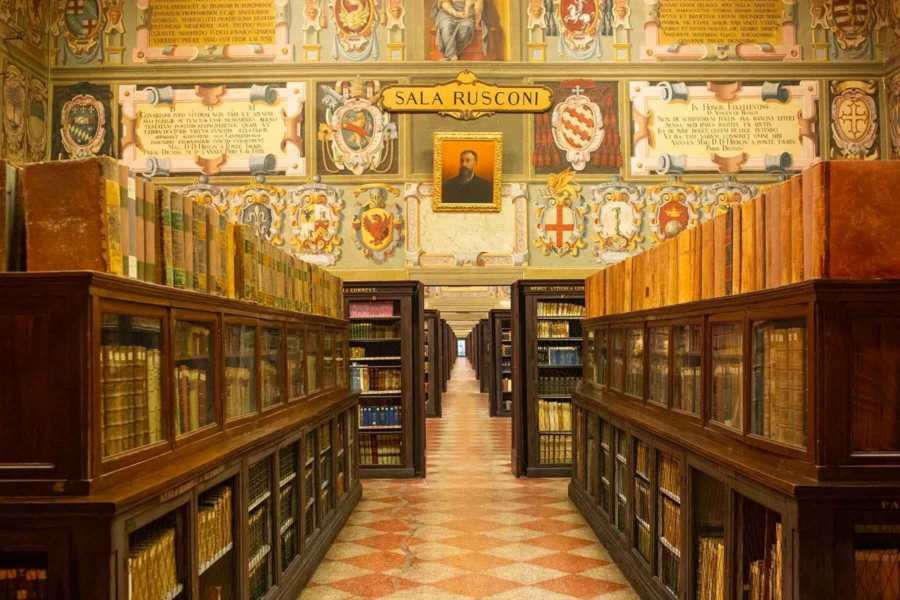
The main reading room has long wooden tables and high windows, and ten more decorated rooms, once the Artists' and Legists' halls, connect off to the side, now used for storage.
Archiginnasio library storage, not bad huh?
Practical info: hours, tickets, and what's free
The library is free, but it's a working reading room, not a tourist stop. Access is for people planning to sit and read or study, not for a quick look around. If that's you, no ticket or booking needed, just check your bag at the entrance.
The Anatomical Theatre requires a paid ticket and booking is mandatory: you can't just show up. Reserve online in advance; tickets are limited by time slot.
Full ticket: €12
Reduced (ages 13–18, university students, over 65): €10
Residents of Bologna / Cultura Card holders: €7
Free for children under 12 and visitors with disabilities plus one companion
Want a deeper look? Book a private history & university tour.
The Archiginnasio and the Anatomical Theatre are just the beginning of the story. The world's oldest university has left secret student graffiti, hidden courtyards, and incredible tales scattered all over the city center. If you want an exclusive, private experience tailored to your group—uncovering these hidden details with a local guide—we can build it for you.
Drop us a line to check availability and plan your private itinerary.
Plan for 45 minutes to an hour if you're visiting both the courtyard and the Anatomical Theatre. The courtyard and loggia can be seen in 15 minutes, but the Theatre alone is worth another 20–30 if you want to actually read the details instead of just glancing around.
Is the Archiginnasio still a university?
No. It was the main seat of the University of Bologna from 1563 until 1803, when the university moved to its current location elsewhere in the city. Today the building houses the Municipal Library and the Anatomical Theatre, both open to the public.
Do I need to book tickets in advance?
For the Anatomical Theatre, yes booking is mandatory and tickets are limited by time slot, so it's worth reserving a few days ahead, especially in high season. The courtyard and library don't require a ticket.
Can tourists visit the library?
Yes, but it's a working reading room, not a sightseeing stop. Access is meant for people who plan to sit and read or study, not for a quick look through the doors. If you're not staying to work, the staff may ask you to move on.
How much does it cost to visit the Archiginnasio?
The courtyard and library are free. The Anatomical Theatre costs €12 full price, €10 reduced, and €7 for Bologna residents or Cultura Card holders. Children under 12 and visitors with disabilities (plus one companion) enter free.
Founder & Local Expert
Hi, I'm Andrea
Born and raised in Bologna, I founded Taste Bologna in 2013 to show the world that there’s more to our food than just recipes. As a local expert featured by the BBC, CNN, and Rick Stein, I’ve dedicated over a decade to finding the most authentic artisans and stories in the city. My goal is to help you eat like a local, not a tourist.
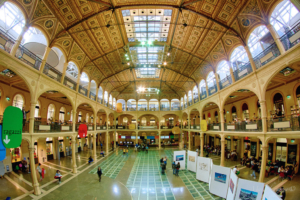
Have you ever heard of a building that’s been a telegraph office, a basketball hall, and even a puppet theatre? If you’re scratching your head, don’t worry.
You’re in Biblioteca Salaborsa library, right off Piazza del Nettuno.
A place that’s transformed countless times over the last 2000 years.
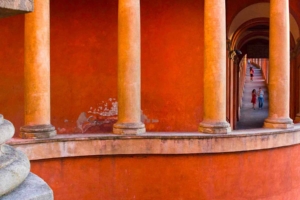
Ever wondered what it feels like to walk through history under the world's longest covered walkway? San Luca Bologna is calling your name. Don't call it just church on a hill, please. It's a pilgrimage, a workout, and a photographer's dream all rolled into one unforgettable experience.The Sanctuary sits atop Colle della Guardia, connected to the city by the world's longest portico: nearly 4 kilome
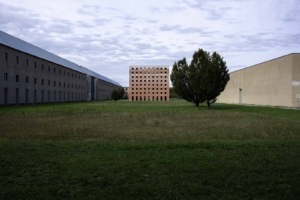
We are a land of middle-aged towers, covered portici, and romantic castles.But the future is unwritten, and many famous contemporary architects have already taken their pen to write it.Explore the remarkable modern architecture in Bologna and Emilia-Romagna.
Tasty newsletter
Stay in touch with monthly news and get my PDF guide with the best restaurants in Bologna and beyond